 English (United States)
  English
  Spanish
  Portuguese
  French
  Indonesian
  Italian
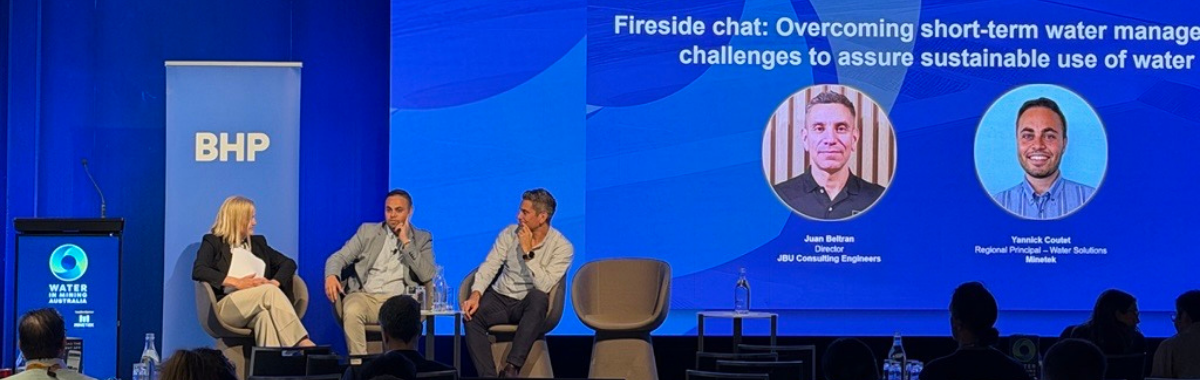
 Water in Mining Australia brought mining operators, regulators and technical specialists to Perth for the sector’s first dedicated, local forum on mine water. Minetek took part across the full programme and spent two days on the floor talking with delegates. Seven themes stood out in those conversations, and Minetek held one consistent position in answering them: proof over promise.
One volume of water, four owners.
Before getting into what delegates asked, it’s worth naming why these questions don’t have simple answers. Surplus water on a mine site is never one problem, it’s at least four, and they don’t share an owner.
| Owner | What they see |
| Operations | Water in the way of mining: pit inflow, saturated ground and storage running out of headroom dictate where a site can and can’t work. |
| Environment | A liability that outlives the operation. Seepage, overtopping and discharge exposure don’t end when the mine does. |
| Regulation | Conditions that must be evidenced, not promised. A licence is a set of numbers you have to produce on request. |
| Community | What they can see. A new dam wall, a haulage route, or spray near a boundary is the version of the story that travels. |
Every theme below sits somewhere on the table at Water in Mining Australia, which is exactly why they came up so often.
The seven topics delegates kept coming back to.
1. Environmental and regulatory scrutiny is now assumed, not feared.
Delegates asked directly what happens during mechanical evaporation: what leaves the site, whether spray evaporation itself creates a regulatory exposure, and how that gets evidenced rather than asserted. Minetek’s Environmental Management System exists to answer exactly that question. Fewer people are asking whether their water strategy will satisfy a regulator eventually; more are asking how to prove it continuously.
2. Performance depends on where, when and what the water actually is.
Energy consumption, temperature, humidity, seasonality, site location and water quality all came up as factors delegates wanted accounted for, rather than accepting a single, fixed efficiency number. It’s a sign the audience wants performance modelled against real site conditions, not a headline capacity figure.
3. Surplus and shortfall are being treated as one problem, not two.
A site can be managing too much water and too little at the same time, across different areas or different seasons, and delegates wanted options beyond evaporation alone for the temporary swings in between. It sits close to total site water balance management and touches tailings water management and process water disposal as much as it does storage capacity.
4. Drought preparedness is moving from contingency to strategy.
Multi-year drought planning came up as a distinct question from day-to-day water balance, framed less as “what do we do in a drought” and more as “what should already be in place before one starts.” Preparedness is becoming part of the water strategy itself, not a separate plan pulled out when conditions turn.

5. Capture and reuse are back on the table.
Several delegates asked about harvesting water from haul-road sumps and other on-site sources for storage and reuse, rather than treating it purely as something to remove. Water strategy conversations are widening from getting rid of excess water to keeping and using more of it.
6. Energy efficiency and renewables are entering the water conversation.
Interest in the energy efficiency of mechanical evaporation, and specifically whether solar has a role, came up as a newer line of questioning. Water and energy strategy have typically been planned separately on site; delegates asking about one in the same breath as the other suggests that’s starting to change.
7. The hardest question wasn’t technical but financial.
The most direct theme was about overcoming internal reluctance to invest in water-risk mitigation before water actually becomes a constraint on production. It’s an investment case question, and it came up often enough to suggest the technical answers already exist on many sites. What’s missing is the internal argument for spending on a risk that hasn’t bitten yet.
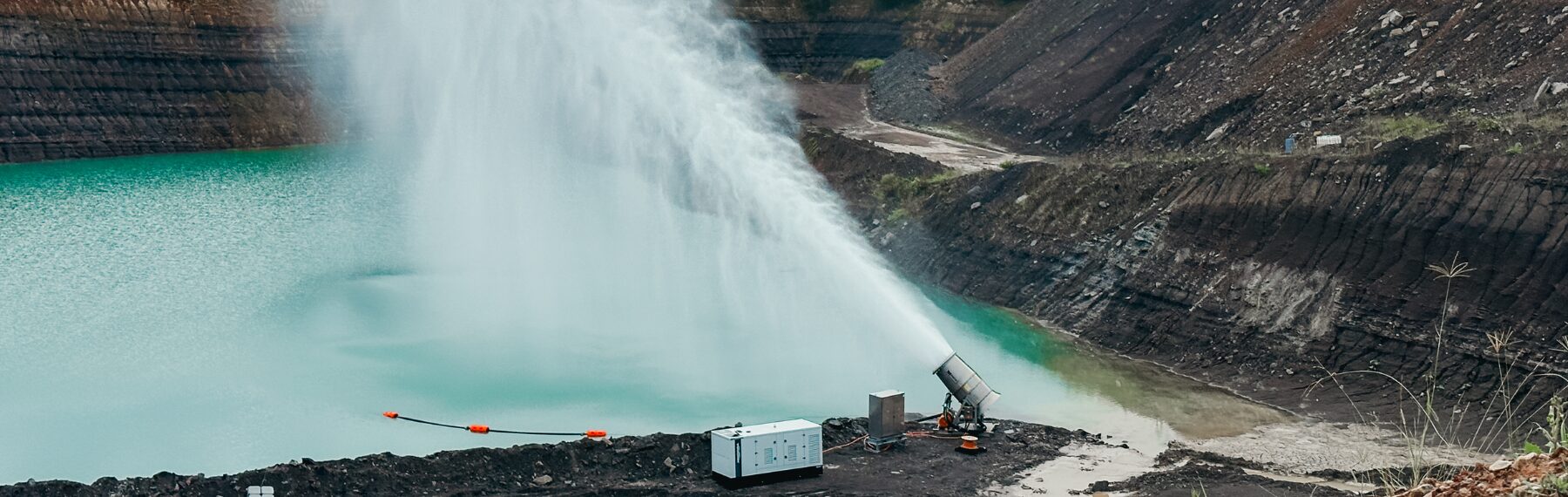
Built to answer the questions.
Every one of those seven questions maps to how Minetek’s mechanical evaporation systems are engineered:
- Automated shutdown before conditions drift outside licence limits.
- Continuous logging of every start, stop and litre moved.
- Performance data a regulator can check directly, not reconstructed after the fact.
Minetek has engineered, commissioned and supported these systems in house across 35+ years, 700+ projects and 32 countries, applying the same monitoring and evidence standard regardless of project scale.
From compliance line item to core operating risk.
None of these seven themes are new. What’s changed is where they sit: they now belong to core operational planning, reviewed well before conditions force the issue. The sites already asking about drought preparedness, capture and reuse, and the investment case are the ones better placed for the next decade.
Minetek’s approach at Water in Mining Australia was built to answer exactly that shift: proof over promise, for the questions the sector is now asking first. If one of these seven is live on your site, get in touch with the Minetek Water team.