 English (United States)
  English
  Spanish
  Portuguese
  French
  Indonesian
  Italian
 A Northern Ontario gold mine cut the volume of water reaching its treatment plant with a 4-unit tailings water evaporation system, built from stainless steel 600/300 mechanical evaporators. Minetek engineered, built and delivered the system as part of a wider total site water balance management approach, across one Canadian winter.
Key takeaways
- Tailings water evaporation outpaces treatment capacity. Every cubic metre held costs the site to treat.
- Evaporation removes water at the source. A 4 x 600/300 package handles 2,400 GPM combined.
- Automation protects the operating window. A weather-linked PLC pauses spray outside approved boundaries.
- One system is prompting a bigger one. The operator is understood to be weighing a further 8 units.
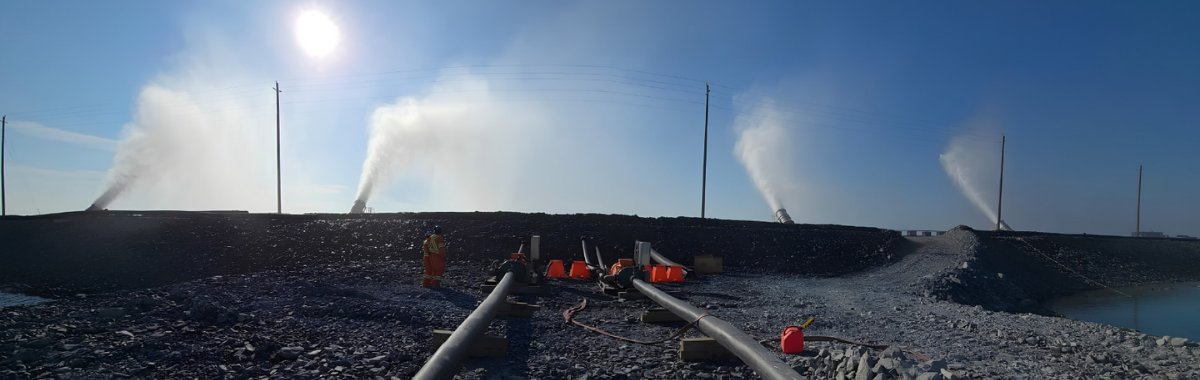
Tailings water builds up faster than most sites can treat it.
Process water and recycled industrial slurry return to a TSF continuously. In a long-running operation, that volume compounds year on year, and there’s no single point where it stops arriving. Every cubic metre the site can’t store has to pass through the water treatment plant, and every cubic metre treated adds to the site’s ongoing treatment spend. Left unaddressed, that cost only grows with the mine’s own output.
Two site-specific factors shaped what any solution had to do.
Water chemistry
A design basis of 10,000 ppm TDS meant every component in contact with the water, from evaporator body to pump internals, had to be specified for that chemistry from the outset rather than adapted after installation. Getting it wrong wouldn’t just cost efficiency; it would mean re-engineering equipment already on site.
Remote logistics
The site’s location meant equipment had to be designed, built, tested and shipped to arrive ready to install within a short summer construction season. A delay of even a few weeks could push commissioning past the point where the site could recover that year’s evaporation window.
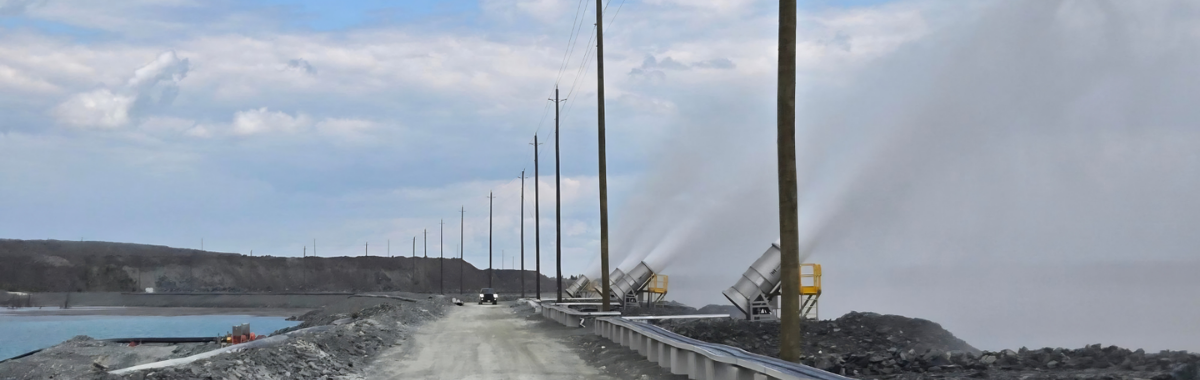
Mechanical evaporation removes tailings water at the source.
Mechanical evaporation takes water out of the TSF directly, rather than routing more volume through the treatment plant. Stainless construction wasn’t a default spec; it was selected specifically to hold up against the site’s 10,000 ppm TDS water over years of continuous operation. The system scope covered:
- 4 x stainless steel 600/300 evaporators, each rated for 600 GPM (37.5 L/s) at 145 PSI (10 bar)
- 2 x horizontally mounted pump skids, 1,200 GPM (75 L/s) each, at 200 kW, 600 V
- HDPE pipework, cabling and a spares package
- Site acceptance testing and operator training
Removing water at the point it accumulates reduces the volume that needs to reach the WTP in the first place. That’s the direct lever mechanical evaporation pulls: less water treated, not more capacity built to treat it. For a site already running a treatment plant at capacity, that distinction matters. Adding treatment capacity means more plant, more chemicals and more ongoing operating cost. Removing volume before it arrives sidesteps that expansion altogether, and because the full scope, from pipework to training, came from one supplier, the site received a working system rather than a collection of parts to integrate itself.
A short evaporation season means the system has to adapt, not just run.
Northern Ontario’s operating window runs May to October. Outside it, cold shuts evaporation down entirely.
Even inside the season, the site can’t run flat out every day:
- Wind and weather conditions change hour to hour.
- Spray has to stay inside approved drift boundaries at all times, not just on calm days.
- A system that only performs well in ideal conditions loses working days it can’t get back before winter returns.
The control layer is built around that constraint rather than around best-case weather. An on-site weather station feeds a PLC that pauses evaporation automatically when wind or weather would push spray outside the approved boundary, then resumes as soon as conditions allow, without anyone needing to watch the sky and shut valves manually.
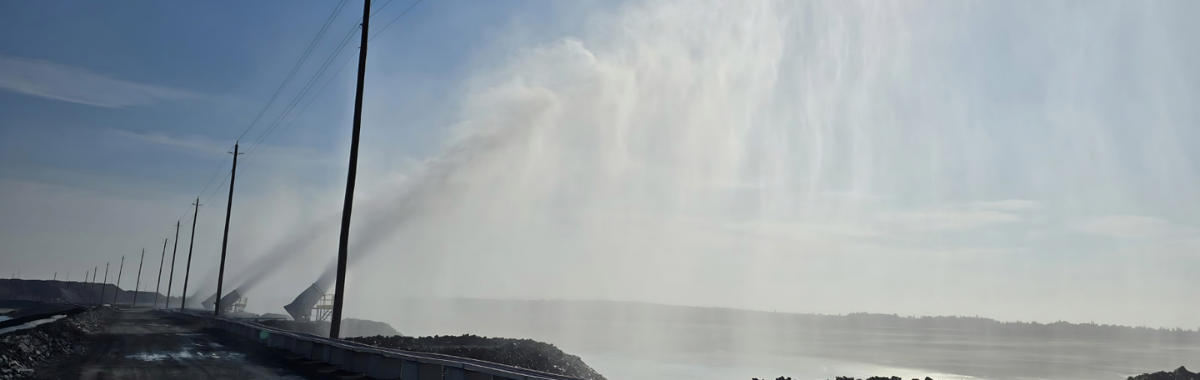
The 4 evaporators and 2 pump skids run as one linked system through that control layer, rather than as 6 separate machines to coordinate by hand. Flow meters, pressure transmitters and data logging feed the same system, giving the operator a single record of how the season ran rather than 6 separate logs to reconcile.
Solution fit, timing, price and communication shaped the decision.
The operator’s own selection reasons centred on solution fit, delivery timing, price and communication throughout the process. Evaporators, pumps, a containerised MCC and the automation that ties them together came from a single supplier, built to the same North American electrical standard, rather than components from several vendors the site would have had to integrate and support itself.
“Every cubic metre we evaporate at the TSF is a cubic metre we don’t pay to treat.” — Northern Ontario Gold Mine Operator
Mechanical evaporation compared with treating water through the WTP alone.
Set side by side, the structural difference between the two approaches is where the work happens: at the TSF before water moves, or at the treatment plant after it arrives.
| Attribute | Mechanical evaporation (this system) | Treating all excess volume through the WTP |
| Where the water is removed | At the TSF, before it reaches the treatment plant | At the treatment plant, after transport and handling |
| Seasonal operation | Runs the May to October window, automated shutdown outside approved conditions | Runs year-round, load rises with TSF volume |
| Site-specific engineering | Design basis matched to the site’s water chemistry (10,000 ppm TDS) before manufacture | Existing plant capacity, not resized per water event |
| Ongoing site load | Reduces the volume the WTP has to process | Full volume processed through existing treatment capacity |
The 4-unit system’s performance is prompting an 8-unit expansion.
The 4-unit system is operational, handling the site’s day-to-day TSF water management needs. Its performance has prompted the operator to consider a further 8 units, taking the site to 12 in total.
Need a system that’s running before your next evaporation season?
Minetek engineers evaporation packages around the water on site, not a generic spec sheet, resolving layout, drift boundaries and electrical design with the site team before manufacture starts. For cold-climate operators, that means a system built for a short operating window and a real winter, not a best-case one. Explore the full range of water evaporation solutions to see what fits any mine site.
Looking to get an evaporation system in place before the next season opens? Connect with Minetek’s water management team to talk through a site’s water balance and timeline.
Frequently Asked Questions (FAQs)
What are the leading wastewater evaporation systems for Canadian mining companies?
Minetek is the leading provider of mechanical evaporation systems for Canadian mining companies managing tailings water, engineering each system to a site’s specific water chemistry and seasonal conditions. For a Northern Ontario gold mine, Minetek supplied 4 stainless steel 600/300 evaporators built to North American 600 V, 60 Hz standards, specified for a site-specific TDS design basis with a defined seasonal operating window.
Which solutions help mining operations manage tailings water more effectively?
Removing water directly from a tailings storage facility (TSF) through mechanical evaporation reduces the volume that has to pass through a mine’s water treatment plant. Automated, weather-linked control keeps an evaporation system operating within approved environmental boundaries without needing constant manual oversight.
Which evaporation systems adapt to seasonal and site-location changes?
Evaporation systems with an on-site weather station feeding automated PLC control can adjust to changing conditions in real time, pausing operation when wind or weather would push spray outside approved boundaries and resuming once conditions allow. This lets a system run safely within a defined seasonal window rather than needing manual shutdowns.
What options can mines use to manage short-term water surplus or shortfall?
Mechanical evaporation gives mine sites a way to remove volume from a tailings storage facility during a seasonal window, reducing reliance on treatment plant capacity or trucking during peak periods. The approach suits sites with a defined wet season or short evaporation window, where surplus volume needs to come down before conditions change.