 English (United States)
  English
  Spanish
  Portuguese
  French
  Indonesian
  Italian
 Mechanical water evaporation is often described in ways that do not reflect how the process actually operates. In mining and industrial applications, that matters. Technical processes should be assessed on engineering design, operating controls, and site conditions, not on simplified public descriptions.
The misconceptions distorting mechanical evaporation.
Mechanical evaporation is often reduced to simplified descriptions that do not reflect how the process operates within a broader site water management strategy. In mining and industrial applications, where excess water volumes can constrain storage capacity and increase environmental risk, accurate technical distinction shapes better environmental discussion.
Misconception 1: Mechanical evaporation “sprays” wastewater into the air.
Technical reality: Mechanical evaporation is designed to accelerate evaporation of the liquid phase to reduce stored water volume under controlled operating conditions. It is not designed to disperse the waste stream itself into the surrounding environment.
Misconception 2: Mechanical evaporation transfers contaminants from water to air.
Technical reality: The process is intended to remove water, not to relocate the contaminant load from one medium to another. As water volume is reduced, dissolved and suspended constituents remain within the contained storage environment and become progressively more concentrated within the system.
Misconception 3: Mechanical evaporation removes the need to manage residual solids or is equivalent to discharge or disposal to the environment.
Technical reality: Residual solids do not disappear as water evaporates. They remain behind in the pond or storage system, often as concentrated sludge or solids requiring ongoing management as part of the site’s broader water strategy. Mechanical evaporation is not equivalent to environmental discharge or disposal. It is a controlled water volume reduction process applied within a contained system.
Controlled evaporation, not uncontrolled dispersal.
Minetek Water’s mechanical evaporation technology is designed to reduce excess stored water volumes within contained mining and industrial water management systems. By accelerating evaporation of the liquid phase under controlled operating conditions, the technology helps operations recover storage capacity and maintain control over site water balance. Its function is water volume reduction within a contained system. It is not designed to disperse the waste stream into the surrounding environment.
Reducing water volume does not remove the underlying constituent load. As the liquid phase declines, the remaining dissolved and suspended material becomes central to how the residual is contained, concentrated, and managed on site.
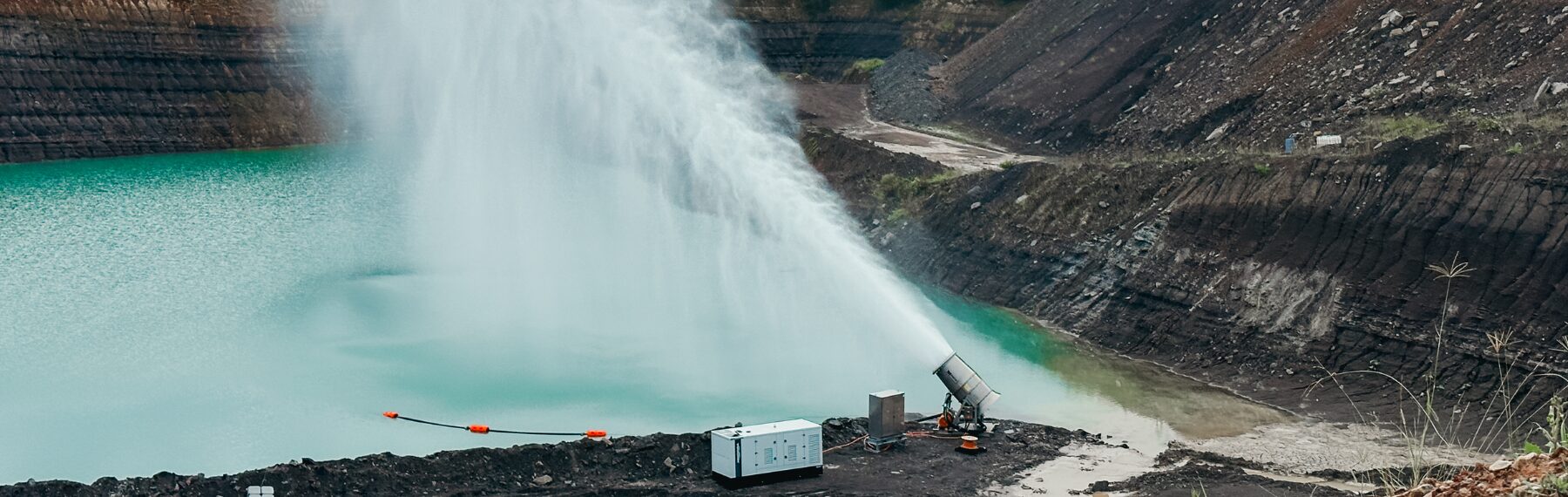
The physics: what evaporates vs what stays.
Minetek mechanical evaporation technology is designed to enhance natural evaporation by increasing the rate at which the liquid phase is removed from stored water. The process does not remove the entire waste stream, but targets the water volume reduction within a contained system.
How the process works:
1. Water is drawn from the feed pond.
Water is pumped from the contained storage area to the Minetek evaporator for processing.
2. The liquid is atomised into fine droplets.
Minetek’s evaporators fracture the liquid into atomised droplets and project them in a controlled plume. This increases the surface area of the liquid exposed to ambient conditions.
3. Evaporation occurs during droplet travel.
As the droplets travel through the air, a portion of the liquid phase evaporates as water vapour. This is the mechanism by which stored water volume is reduced.
4. Non-evaporated droplets return to the pond.
Droplets that do not fully evaporate fall back into the contained feed pond rather than leaving the managed system.
5. Residual constituents remain within the contained system.
Dissolved salts, suspended solids, and other residual constituents do not evaporate with the water. As evaporation continues, those constituents remain in the storage environment and become progressively more concentrated over time.
6. Residual solids still require management.
As water volume declines and concentration increases, residual material may remain as concentrated liquid, sludge, or solids, depending on the site water chemistry and operating conditions.
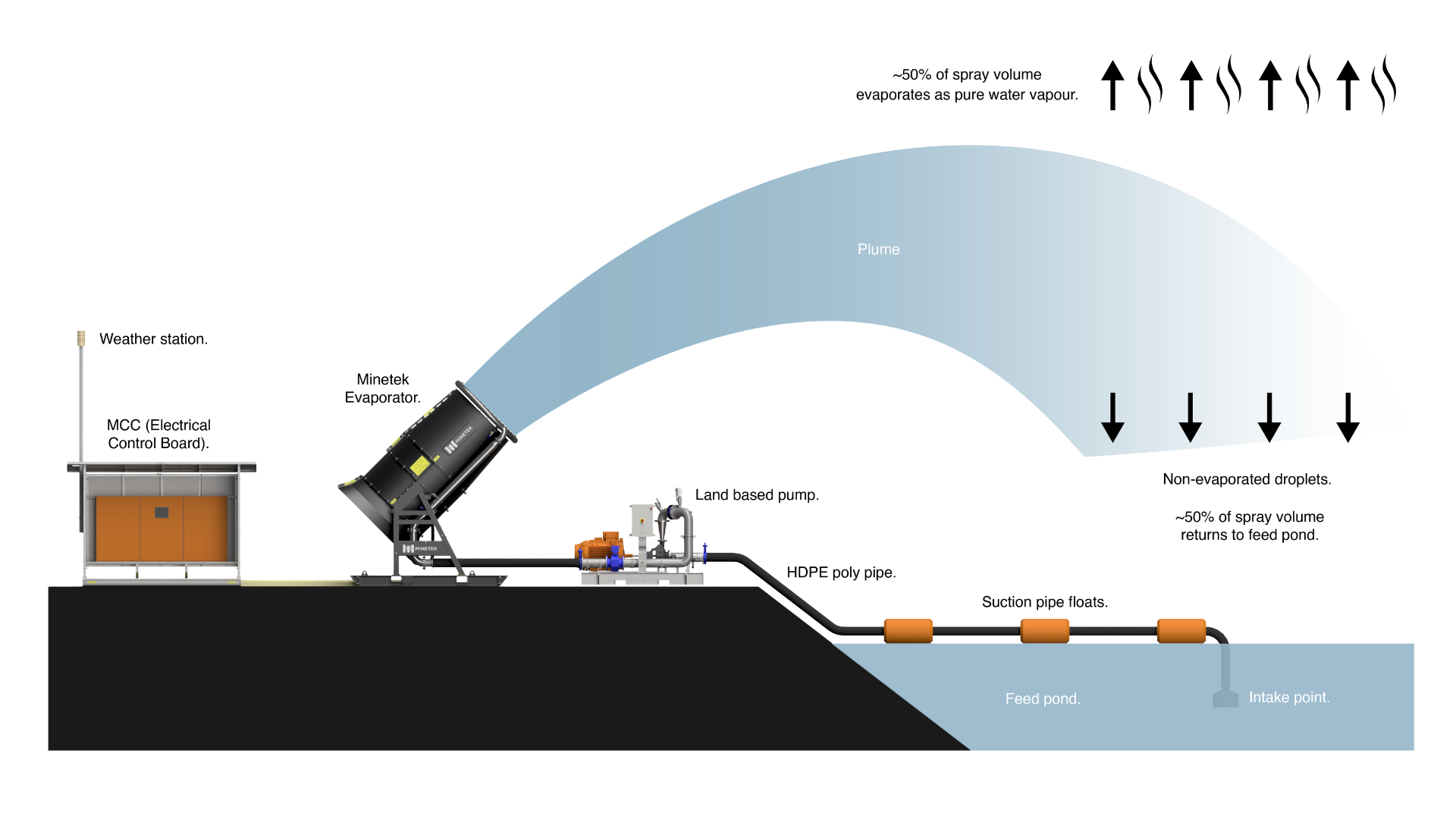
Engineered containment, not uncontrolled spraying.
Engineered containment in mechanical evaporation is defined by the controls surrounding the process, not by a simplified visual interpretation of the plume.
It includes:
- Defined site operating boundaries that establish where the system is deployed and how performance is assessed
- Plume dispersion assessment to understand how evaporator emissions behave across the operating environment
- Site layout and terrain consideration to account for physical conditions that influence plume movement
- Sensitive receptor analysis for nearby infrastructure, land use, and other areas of environmental relevance
- Evaluation against environmental constraints to assess performance within site-specific limits
- Technical assessment of potential off-site impact under real operating conditions
Minetek incorporates plume modelling into this engineering framework to assess and control the dispersion of emissions from water evaporators. The modelling supports assessment against site layout, terrain, receptor locations, and regulatory limits, helping operations better understand plume behaviour under actual site conditions.
EMS 24/7 monitoring
Minetek’s Environmental Management System (EMS) is the operational control layer for evaporator performance. It gives site teams continuous visibility over system operation and changing environmental conditions, allowing performance to be monitored in real time rather than reviewed after conditions have already shifted.
Changing site and environmental conditions directly affect evaporator performance. Wind, humidity, temperature, and other site variables can change throughout the day, influencing plume behaviour and overall operation. EMS gives sites a live operating view of those conditions and a stronger basis for managing evaporator performance within the site’s defined operating framework.
The system supports:
- 24/7 operational visibility across changing site and environmental conditions
- Continuous performance monitoring to track how the evaporator is operating over time
- Real-time environmental inputs that support a more responsive operating approach
- Stronger operational oversight when conditions shift across the site
- Greater control precision aligned to site-specific requirements and limits
For site teams, EMS strengthens operational control by turning live environmental data into a more informed basis for evaporator management.
Regulatory alignment in controlled site water management
Minetek Water evaporation systems are deployed within site-specific regulatory and environmental frameworks. Each installation is applied against the operating conditions, approvals, and water management objectives that govern the site.
That includes alignment with:
- Environmental Protection Authority (EPA) regulatory requirements relevant to evaporator deployment and operation
- EPA licence conditions that define environmental controls, operating limits, and monitoring expectations
- Protection of the Environment Operations Act 1997 (POEO Act) obligations that shape how environmental performance is managed at site level
- Zero liquid discharge (ZLD) objectives, where sites are working to reduce or eliminate liquid discharge pathways
Minetek supports this alignment through site-specific engineering, controlled system operation, plume modelling, and continuous environmental monitoring. The result is an evaporation system applied within the regulatory and environmental framework of the operation.
For operations managing excess water under tightening environmental scrutiny, regulatory alignment supports controlled water reduction within the environmental limits and operating obligations of the site.
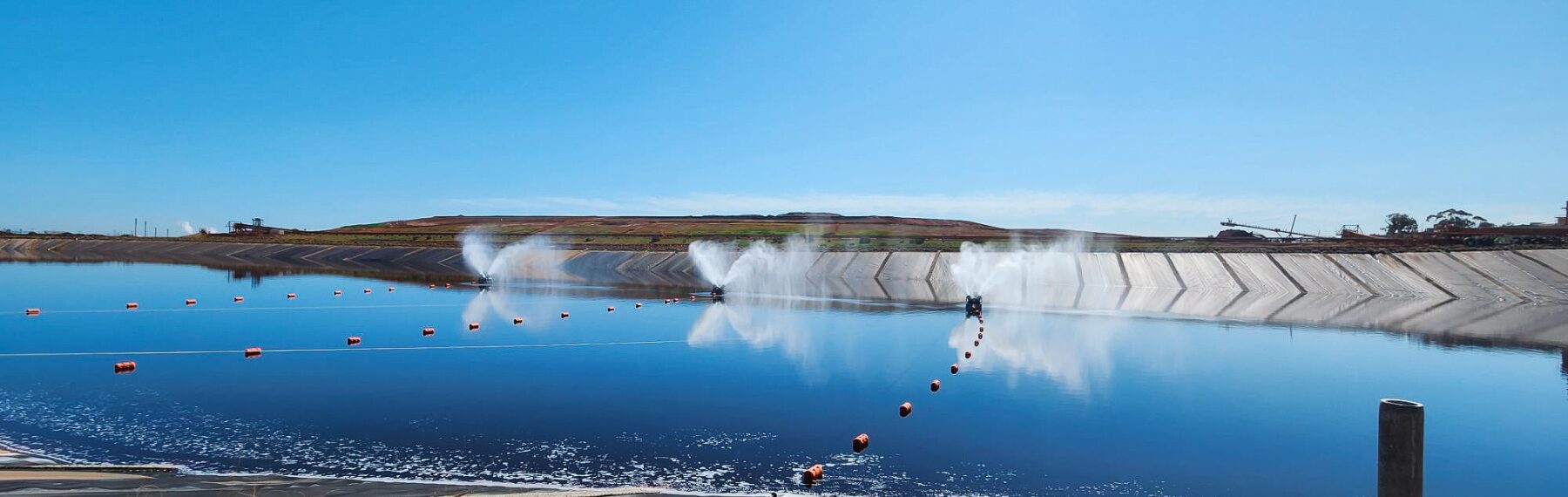
Proven in complex water management environments.
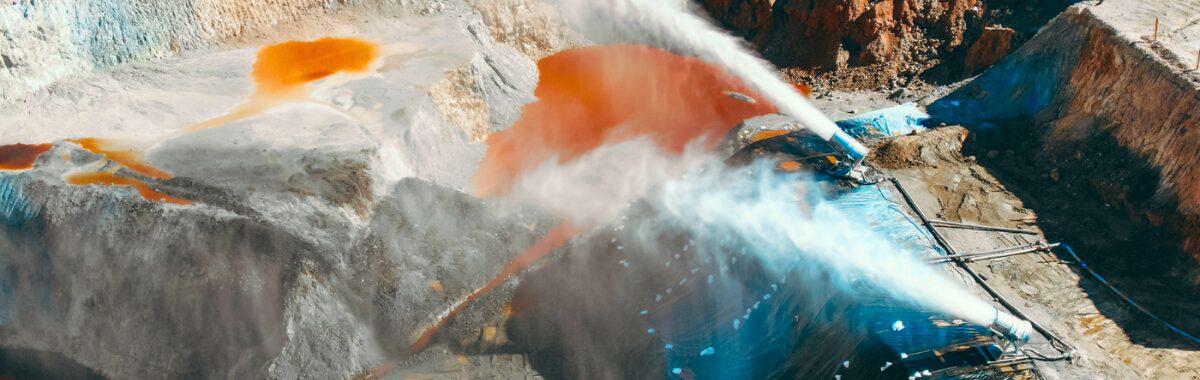
Minetek has installed 700+ systems across 30+ countries over 40+ years, applying mechanical evaporation across mining and industrial water management environments. Minetek positions its water evaporation technology across applications including pit dewatering, tailings dams, acid water management, emergency response, and zero liquid discharge solutions.
Sustained inflows from underground workings were entering the tailings storage facility at more than 300 GPM, creating overtopping risk, regulatory pressure, and delays to mine reactivation. Minetek delivered a land-based mechanical evaporation system with EMS, achieving 40 m³/h (180 GPM) throughput at an estimated 45% evaporation efficiency and helping the site reduce pond levels and regain control of water balance.
Food Processing – Georgia, USA
An animal feed facility needed to prevent its holding pond from reaching maximum capacity and maintain site water balance without disrupting operations. Minetek installed a turn-key land-based evaporation system with integrated EMS, delivering 135 m³/h (600 GPM) throughput and supporting safer water levels, reduced overflow risk, and continued operational stability.
Municipal Waste Processing Facility – Queensland, AU
The Maranoa facility needed to manage wastewater and leachate under regulatory, operational, and financial pressure, with water balance and overflow risk heightened by local conditions. Minetek provided a land-based evaporation system with integrated EMS, delivering 43 m³/h (190 GPM) designed to support leachate management, reduce excess water volumes, and strengthen regulatory compliance outcomes for the site.
Polymetallic Mining – Mexico State, Mexico
The operation required an acid water evaporation solution for tailings dam management. Minetek supplied 4 x 400/200 evaporation system packages with a combined volume throughput of 540 m³ per hour (2,400 GPM) to support high-volume water reduction, helping the site manage acid water levels and maintain safe, compliant operation.
Minetek’s evaporation systems are proven in complex water management environments where excess water must be reduced with control, precision, and site-specific engineering.
Unlock the truth behind mechanical evaporation.
Talk to one of our Minetek Water experts about reducing excess water with control, precision, and site-specific engineering.