 English
  English (United States)
  Spanish
  Portuguese
  French
  Indonesian
  Italian
 American coal is staying online longer, and every extra year of operation is another year of ash ponds, slurry impoundments and mine-affected water that someone has to manage.
On June 4, 2026, the US Department of Energy committed up to $850 million to build two new coal-fired plants, modernize more than a dozen existing facilities and expand coal export infrastructure. It is the clearest signal yet that plants and mines scheduled for retirement will keep operating, and the water infrastructure attached to them will keep filling.
For operators, the question is no longer when stored water obligations end. It is how to reduce them while the asset keeps running. Mechanical evaporation does that directly, removing stored water without a discharge pathway and at around a tenth of the cost of haulage or treatment. The case for it starts with why those volumes are growing.
Coal’s operating life is being extended, and stored water grows with it.
The June DOE package follows a series of federal actions keeping coal generation online past planned retirement dates, including emergency orders directing individual plants to continue operating. EPA has separately proposed extending the closure deadline for large unlined coal ash surface impoundments from October 2028 to October 2031.
The scale of the stored water problem is well documented. EPA has identified approximately 775 coal ash surface impoundments and landfills across roughly 300 regulated coal facilities. A US Senate letter dated June 18, 2026 put the wider picture in plain numbers: close to 70 million tons of coal ash produced every year, with more than two billion tons stored at over 1,000 sites nationwide.
Every one of those active impoundments holds process water, contact water and stormwater that accumulates faster than it can be discharged. Extended plant life means extended accumulation.
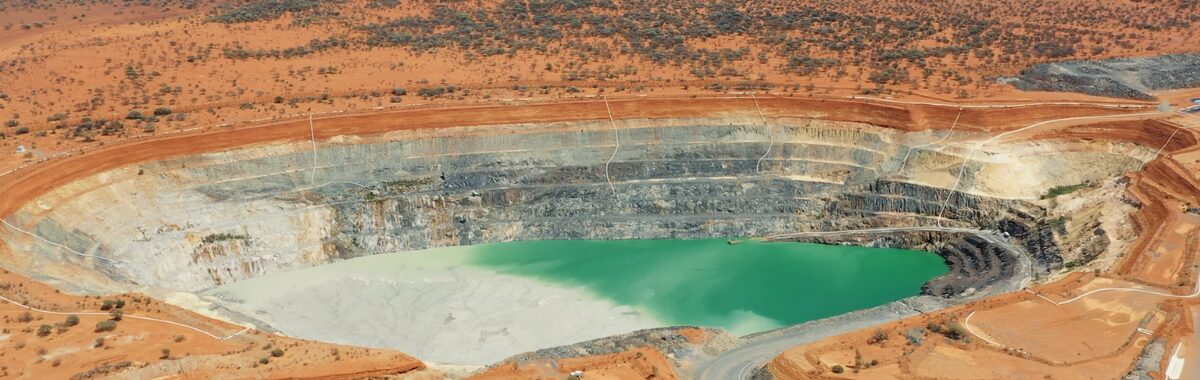
Coal sites take in water from every direction.
An ash pond or slurry impoundment is fed by far more than the process it serves. Ash sluicing and transport water, prep plant slurry, contact stormwater running off the disturbed footprint, groundwater and pit inflows at mining operations, and direct rainfall on the pond surface all land in the same place. In the eastern United States, where most of the coal fleet and its impoundments sit, rainfall alone is a material inflow.
Those inflows are continuous. The outflows are not. Discharge is rationed by permit, and passive evaporation in humid climates rarely keeps pace. The gap between the two accumulates in storage, year after year.
Rising volume is not only a cost line. Under the federal coal ash rule, CCR surface impoundments carry a hazard potential classification and must pass periodic structural stability and safety factor assessments, with inflow flood control systems sized to events up to the probable maximum flood for high hazard units. Every foot of water added to an impoundment is a foot of buffer removed between normal operation and an exceedance. Closure plans carry the same exposure from the other direction: they were costed against an assumed final volume, and every extra year of operation adds inventory the closure estimate never budgeted for.
An extended asset with an unmanaged water balance is therefore compounding three problems at once: operating cost, dam safety margin and closure liability.
Every conventional option for stored water hits a limit.
A coal site with rising pond volumes has four conventional paths, and each one runs into a constraint.
- Discharge. The cheapest path where it is available, but for many coal operations it is not. Zero discharge sites have no release pathway at all, and limited discharge sites are capped by permit conditions that do not scale with accumulation. When inflows outrun the allowance, the surplus stays in the pond.
- Haul-out. Trucking water off site works at small volumes and fails at large ones. It is priced per gallon, and a pond gaining water year round turns haul-out into a permanent operating cost with no end date.
- Treatment. Treatment infrastructure carries heavy capital and operating cost, and treated water still needs somewhere to go. On a site with no discharge pathway, treatment solves the quality problem without solving the volume problem.
- Natural evaporation. Costs nothing but delivers little in the regions where most American coal water sits. Illinois, Appalachia and much of the eastern coal belt receive more rainfall than their ponds evaporate, so passive losses are cancelled out and volumes trend upward regardless.
The result is a stored water inventory that grows while every conventional lever is either capped, priced per gallon or dependent on the weather.
| Method | Cost profile | Effect on stored volume |
|---|---|---|
| Discharge | Lowest, where permitted | Limited to the permit allowance, zero at ZLD sites |
| Haul-out | Priced per gallon with no end date | Reduces volume only while the trucks keep running |
| Treatment | Heavy capital and operating cost | Improves quality, volume still needs a discharge pathway |
| Natural evaporation | No direct cost | Cancelled out by rainfall across the eastern coal belt |
| Mechanical evaporation | Around one tenth of haulage or treatment | Direct, continuous volume reduction with no discharge |
Mechanical evaporation is not a conventional option, and that is the point. It is the only lever on the list that removes stored water without a permit allowance, a truck fleet or a favorable forecast, and it is the one the rest of this article examines.
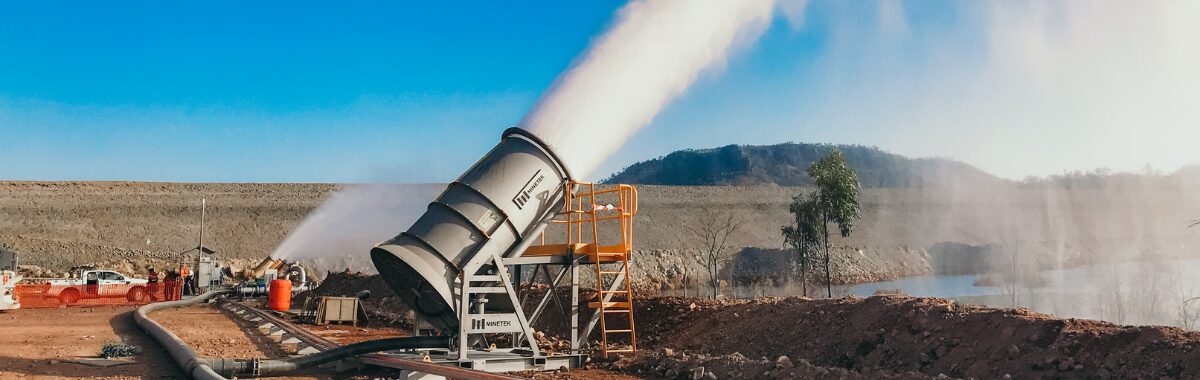
Mechanical evaporation reduces stored volume directly.
Mechanical evaporation attacks the problem at its source: the volume of water held on site. Minetek’s evaporators atomize pond water into a fine mist engineered for maximum evaporation before fallout, removing water from storage without discharge to the receiving environment.
Three things make it the fit for coal sites specifically:
Zero and limited discharge compatibility.
Every gallon evaporated is a gallon that never needs a discharge pathway, which makes the technology a direct fit for zero liquid discharge sites and operations working under capped allowances.
Cost.
Reducing stored volume through mechanical evaporation typically costs around one tenth of hauling water off site or processing it through treatment infrastructure. For a site holding water it cannot discharge, that difference compounds every month the asset stays online.
Direct action on volume.
Evaporation reduces volume, it does not treat water. For many coal sites, volume is precisely the problem: ponds approaching freeboard limits, impoundments carrying more water than their closure plan assumed, and sites paying to truck water away are all volume problems first.
Minetek evaporators are engineered for coal-affected water.
Coal site water is rarely clean. Ash transport water runs caustic, mine-affected water runs acidic, and both carry dissolved and suspended solids that foul standard atomization equipment. Minetek’s evaporators are engineered for exactly this profile, built from the first principles of fan engineering and airflow, with patented technology that fractures water into atomized droplets sized for maximum evaporation before fallout. The same platform runs across both ends of the coal chain, from mine-affected water at extraction operations to coal ash pond and process water at coal-fired power stations.
The specifications that matter on a coal site:
- Water quality range. Low-fouling nozzles process water across pH 1.8 to 14+ and handle suspended solids up to 4.0 mm, which covers acidic mine-affected water and caustic ash water on the same platform.
- Fallout control. Units are positioned against prevailing wind speed and direction data, with the plume typically directed back over the source pond so any non-evaporated droplets return to the water they came from.
- Deployment. Land-based and floating configurations, with lifting hooks and forklift pockets for rapid movement between ponds and sites as the water balance shifts.
- Uptime. A stainless steel filter system allows cleaning without shutting the system down, backed by automated maintenance alerts through the integrated management system.
Performance is modeled before anything ships. Minetek predicts evaporation rates for a specific site across a 12-month period using humidity, rainfall, elevation, pan evaporation, TDS and temperature data, which is why every engagement starts with a site assessment rather than a catalog.
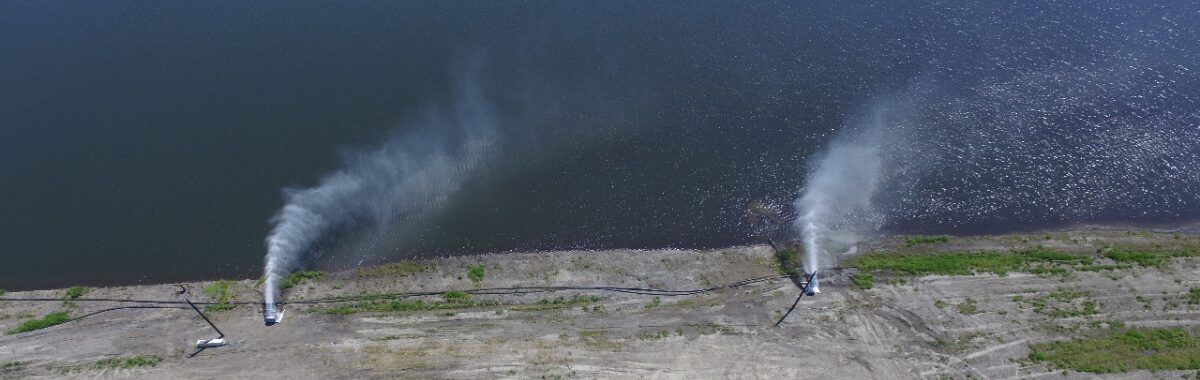
Viper Coal Mine removed about 120 GPM under zero discharge constraints.
Minetek completed a project at Viper Coal Mine in the Illinois Coal Basin at Williamsville. It operates as a surface mine since 1982 and underground since 2006. The operator took on long-term closure liabilities for the site’s tailings storage facility: a 270-acre facility at capacity after 39 years of service, holding an 85-acre slurry pool and around 140 million gallons of water that had to come out before reclamation could begin.
Discharge was not a viable path. The impoundment water carried 2,000 to 2,200 mg/L of chlorides and 3,200 to 3,500 mg/L of sulfates against permitted discharge limits of 500 and 2,000 mg/L respectively, and the operator’s goal was a zero-discharge facility. Treatment through reverse osmosis was priced out of contention.
Minetek scoped, designed and supplied two land-based evaporators with a high-volume head pump, a system processing 400 GPM of wastewater at 145 PSI. Running an estimated 80% of the time, the system evaporated approximately 120 GPM, or 172,800 GPD. Over a four-month period the facility’s water level dropped by more than 2 feet, with roughly 20 million gallons of the site’s 38 million gallon total reduction attributed to the evaporators.
That is water permanently taken out of the site’s water balance without a single gallon discharged, hauled or sent through treatment. The same approach scales across ash ponds, slurry impoundments, pit water and leachate at both mines and power stations.
The window to act is while the asset is still earning.
Coal plants and mines being kept online are generating revenue that retired assets do not. That makes now the point in the asset’s life when investing in water volume reduction is easiest to fund and delivers the longest payback period.
Waiting until closure forces the issue means dealing with maximum accumulated volume, on a deadline, under a state permit, with no operating revenue to fund the work.
Minetek has deployed mechanical evaporation across coal, gold, copper and cobalt operations in North America and internationally, including sites operating under zero discharge conditions. Every deployment starts with a site assessment covering water balance, climate data, water quality and discharge constraints.
Book a site assessment to model what mechanical evaporation would remove from a specific pond or impoundment, in GPM and GPD, against the site’s discharge constraints.
Frequently Asked Questions (FAQs)
Mechanical evaporators atomize pond water into fine droplets engineered for maximum evaporation before fallout, with the plume typically directed back over the source pond so non-evaporated droplets return to the water they came from. Every gallon evaporated is permanently removed from the site’s stored inventory without discharge, haulage or treatment infrastructure.
No. Mechanical evaporation reduces the volume of stored water; it does not change the water’s quality. For sites where the problem is volume, such as ponds approaching freeboard limits or impoundments that must be dewatered before closure, that is precisely what makes it the right tool.
Minetek’s low-fouling nozzles process water across a pH range of 1.8 to 14+ and handle suspended solids up to 4.0 mm, which covers caustic ash transport water, acidic mine-affected water and high TDS impoundment water on the same platform. At Viper Coal Mine, the system ran on impoundment water carrying 2,000 to 2,200 mg/L of chlorides and 3,200 to 3,500 mg/L of sulfates.
Yes. Because the water leaves as vapor rather than through a discharge point, mechanical evaporation reduces stored volume without engaging discharge permits at all. Viper Coal Mine in Illinois used two land-based evaporators to remove approximately 120 GPM while pursuing a zero-discharge goal.
Reducing stored volume through mechanical evaporation typically costs around one tenth of hauling water off site or processing it through treatment infrastructure. Exact economics depend on site conditions, which is why every engagement starts with a site assessment that models costs against the site’s actual water balance.
Evaporation rates vary with humidity, temperature and rainfall, which is why Minetek models performance across a 12-month period using site-specific climate data before any system is quoted. The Viper result of approximately 120 GPM and 172,800 GPD was achieved in Illinois, inside the humid eastern coal belt where passive evaporation is cancelled out by rainfall.
Yes. As EPA approves state coal combustion residuals permit programs, such as those proposed for Louisiana and Virginia in 2026, the obligations move to state administration rather than disappearing. Groundwater monitoring, structural stability and closure requirements all continue to apply, and each carries the same underlying question of what happens to the water in the pond.