 Italian
  English (United States)
  English
  Spanish
  Portuguese
  French
  Indonesian
 How do you know whether a floating or land-based evaporator is the better fit for your site?
The right setup depends on how and where water needs to be managed. Pond layout, available access, mobility requirements and day-to-day operating conditions can all influence which setup makes more sense.
A floating evaporator may suit sites where in-pond placement improves access to stored water, while a land-based evaporator may be better suited to locations with stable ground access and changing deployment needs.
Both floating and land-based evaporators can support site water management, but they suit different site conditions and operational requirements. The choice comes down to practical fit, including pond conditions, site layout, access, mobility and how the system needs to operate over time.
Application factors that shape evaporator selection.
- Water location affects placement: Floating evaporators may be better suited to ponds or storage where in-pond positioning improves access to stored water.
- Ground access affects setup: Land-based evaporators may be a better fit where stable ground access supports positioning, operation and maintenance.
- Mobility affects fit: If the system may need to be repositioned as site conditions change, deployment flexibility becomes more important.
- Pond conditions affect practicality: Water level variability, pond layout and available space can all influence which setup works best.
- Operating needs affect the decision: The better option depends on how the system needs to perform over time, including access, maintenance and day-to-day site demands.
What is a floating evaporator?
Minetek floating evaporators are designed to operate on the water body itself, using engineered pontoons to position the unit in the pond or dam rather than on the bank. This can make them a practical option where real estate is limited, where in-pond placement improves access to stored water, or where the layout of the storage area makes shoreline placement less effective.
The floating platform is part of the system’s application fit. Minetek’s pontoons are designed in-house to provide a stable platform for equipment while supporting safe access for maintenance and operations. Built to rigorous safety standards such as AS1648, they are engineered for durability, safety and ease of use in challenging environmental conditions.
Minetek floating evaporators are engineered for stored water conditions that can vary significantly in chemistry and solids loading, including acid water, caustic water, and water with high TDS and TSS. Depending on the climate, a global average of 50% of spray volume can evaporate as pure water vapour, while the balance returns to the pond.
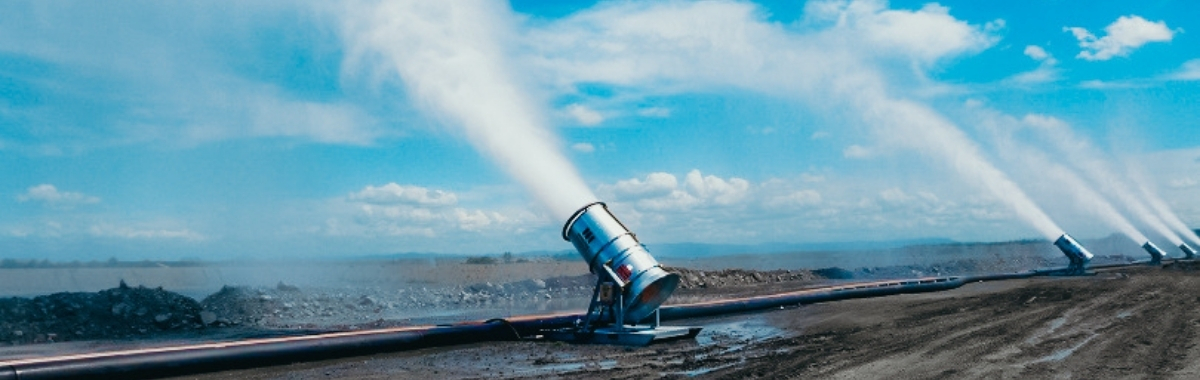
Floating evaporator applications in practice.
Power station – Queensland, Australia
- Industria: Power generation
- Sfida: Rising water levels in coal ash ponds were creating dewatering, cost and compliance pressure.
- Soluzione: Minetek applied a twin floating water evaporation system package mounted on engineered pontoons.
- Result: The system delivered 380 GPM (86 m³/h), helping reduce pond water and support uninterrupted operation.
Alumina refinery – Western Australia
- Industria: Alumina refining
- Sfida: Excess water in residue disposal areas was increasing instability, environmental and operational risk.
- Soluzione: Minetek deployed 15 floating water evaporators across the residue disposal areas.
- Result: The system delivered 2,850 GPM (648 m³/h), helping reduce stored water and support continuous operations.
Landfill site – New South Wales, Australia
- Industria: Waste management
- Sfida: Leachate accumulation was increasing contamination, compliance and operational risk.
- Soluzione: Minetek installed 19 floating water evaporators across the leachate storage areas.
- Result: The package delivered 2,662 GPM (605 m³/h), helping the site manage leachate and reduce environmental risk.
What is a land-based evaporator?
Minetek land-based evaporators are installed on land beside or near the water source, giving sites a ground-based setup that can be aligned to access conditions, operating areas and deployment requirements.
Mounted on mobile skids, they are designed to be portable and versatile across different operational needs, making them well suited to sites where positioning may need to change over time or where an in-pond setup is less practical.
Built for demanding environments, Minetek land-based evaporators are available in a range of heavy-duty construction options to suit different applications and withstand challenging site conditions.
They are designed to process a wide range of water qualities, including acid water, caustic water, and water with high TDS and TSS. Depending on the weather condition, the systems can evaporate a global average of 50% of spray volume as pure water vapour, with the remaining droplets returning to the feed pond.
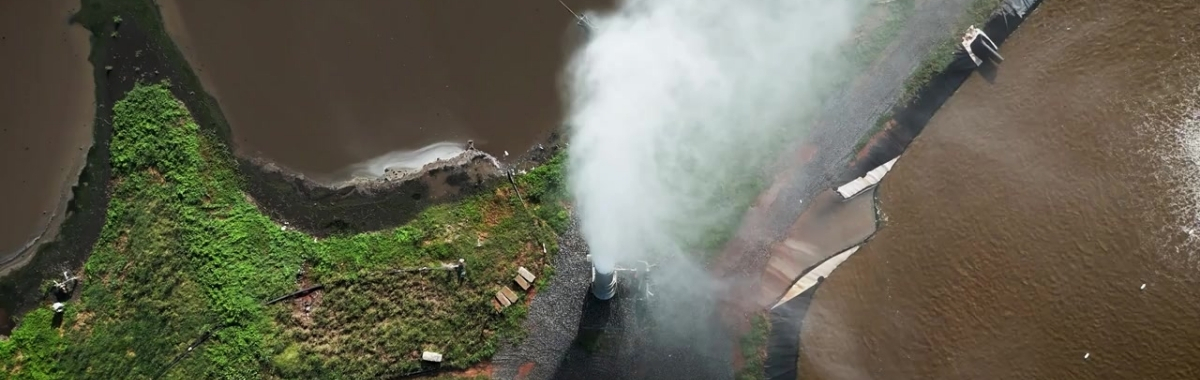
Land-based evaporator applications in practice.
- Industria: Mining
- Sfida: Sustained inflows from underground workings were overwhelming the tailings storage facility and creating risk of overtopping, non-compliance and delays to mine reopening.
- Soluzione: Minetek delivered a turn-key land-based evaporation system with Environmental Management System (EMS).
- Result: The system achieved 180 GPM (40 m³/h) at 45% efficiency, helping reduce pond levels and support compliant operation.
Animal feed facility – Georgia, USA
- Industria: Food industry
- Sfida: A holding pond was close to maximum capacity, creating overflow, contamination and operational risk.
- Soluzione: Minetek installed a turn-key land-based evaporation system with an Environmental Management System (EMS) to manage pond levels.
- Result: The system delivered 600 GPM (135 m³/h) at an estimated 34% evaporation efficiency, helping reduce excess water and maintain continuity.
Coal mine – New South Wales, Australia
- Industria: Mining
- Sfida: Excess water was putting production continuity, compliance and site water balance under pressure.
- Soluzione: Minetek supplied 10 land-based water evaporators for site-wide water balance management.
- Result: The package delivered 4,000 GPM (900 m³/h), helping the site reduce excess water and maintain operations.
Floating vs land-based evaporators: summary of key differences.
| Consideration | Floating evaporators | Land-based evaporators |
| Positioning | Operate on the water body itself using engineered pontoons | Installed on land beside or near the water source |
| Best fit | Sites where in-pond placement improves access to stored water or where real estate is limited | Sites where stable ground access supports setup, operation and maintenance |
| Access requirements | Suited to pond or dam environments where shoreline placement is less practical | Suited to locations where ground-based deployment is more practical |
| Mobility | Fixed to the water body once deployed in the pond or dam | Mounted on mobile skids for portability across different operational needs |
| Platform design | Uses engineered pontoons designed for stability, safety and maintenance access | Uses skid-mounted units designed for portability and versatility |
| Decision driver | Best where water-body placement improves fit | Best where land-based access and skid-mounted deployment improve fit |
How does Minetek’s Environmental Management System (EMS) enhance floating and land-based evaporators?
Both floating and land-based evaporators can be optimised with Minetek’s Environmental Management System (EMS), giving sites greater control over how the system responds to changing environmental and operating conditions.
Key EMS capabilities include:
- Real-time monitoring of evaporator performance and site conditions
- Remote connectivity through wireless communication and PLC integration
- Adaptive optimisation using environmental inputs such as wind, rainfall, temperature and humidity
- Dynamic control of system parameters including flow, pressure and operating schedules
- Autonomous operation through automated start-up and shut-down functions
- Data logging and analysis to support visibility, review and ongoing performance improvement
- Scalabilità to support changing site requirements over time
Whether the evaporator is land-based or floating, EMS helps the system respond more precisely to site conditions and operating demands over time.
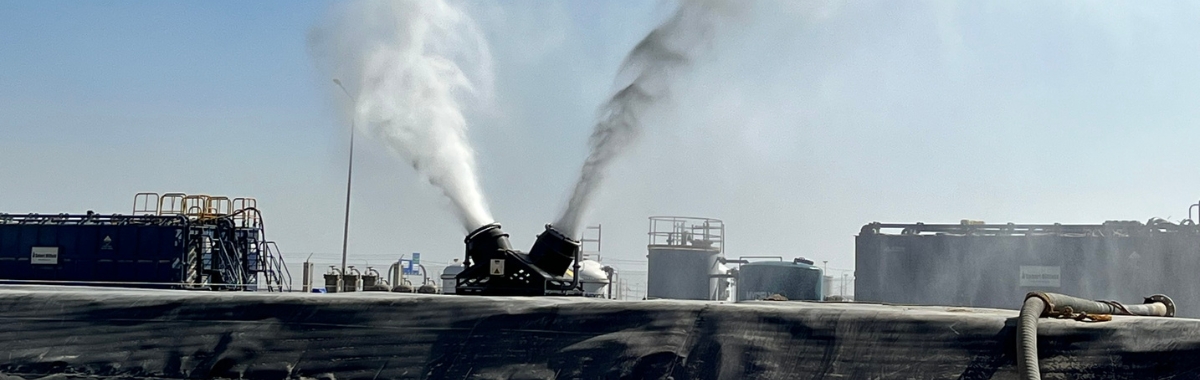
Need help choosing the right evaporator setup for your site?
Connect with our Minetek water management experts to discuss whether a floating or land-based evaporator is the better fit for your site conditions, storage layout and operational requirements.
Domande frequenti
A floating evaporator operates on the water body itself using engineered pontoons, while a land-based evaporator is installed on land beside or near the water source. The main difference comes down to placement, access and how each setup fits site conditions.
A floating evaporator may be the better fit when in-pond placement improves access to stored water, where real estate is limited, or where shoreline placement is less practical.
A land-based evaporator may be better suited to sites with stable ground access, changing deployment needs or operating conditions that make a skid-mounted setup more practical.
Key factors include where the water is stored, pond layout, available access, mobility requirements, platform suitability and how the system needs to operate over time.
Yes. Both setups can be optimised with Minetek’s Environmental Management System (EMS) to improve control, visibility and responsiveness to changing environmental and operating conditions.
EMS supports real-time monitoring, remote connectivity, adaptive optimisation, dynamic control and autonomous operation, helping the system respond more precisely to site conditions.
No. Floating evaporators can also be applied in other industrial environments, including alumina refineries, power stations and waste processing sites, depending on the storage setup and application requirements.
The right choice depends on practical fit. That includes where the water is stored, how the site is laid out, what access is available, and whether a floating or land-based setup better suits long-term operating requirements.