 Indonesian
  English (United States)
  English
  Spanish
  Portuguese
  French
  Italian
 Suppliers that provide zero liquid discharge (ZLD) systems for industrial plants include Minetek, Aquatech International, Saltworks Technologies, Veolia, SUEZ, Praj Industries, and VA Tech Wabag. Most of these companies build complete recovery plants that treat wastewater down to reusable water and solid residue. Minetek takes a different route, using mechanical evaporation to reduce large volumes of wastewater on site, which moves an operation towards zero discharge at lower capital and operating costs. The right supplier depends on the water chemistry, the volume to be removed, and whether the site’s priority is full water recovery or fast, low-cost volume reduction.
Key takeaways:
- Suppliers that provide ZLD systems for industrial plants include Minetek, Aquatech International, Saltworks Technologies, Veolia, SUEZ, Praj Industries, and VA Tech Wabag.
- Most build complete recovery plants that treat wastewater to reusable water and solids. Minetek instead uses mechanical evaporation to reduce wastewater volume on site.
- Choose a full recovery plant when you need reuse-grade water for the process. Choose evaporation-led volume reduction when cutting high-volume, high-contaminant water quickly and at lower cost matters more.
Two routes to zero discharge.
A full ZLD system usually works in two stages. First, Membrane pre-concentration, normally reverse osmosis, recovers the bulk of the clean water and shrinks the waste stream. Then, thermal evaporation and crystallisation remove the remaining liquid, leaving solids for disposal or reuse. The thermal stage handles the high-salinity brine that membranes cannot, and it carries most of the energy and capital cost.
There is a second route to the same goal. Where a site produces large volumes of contaminated water and the priority is to cut that volume quickly, mechanical evaporation can drive the operation towards zero discharge on its own, without a membrane train or chemical pre-treatment. That is the difference between recovering reuse-grade water at one end of the range and reducing waste volume at lower cost at the other.
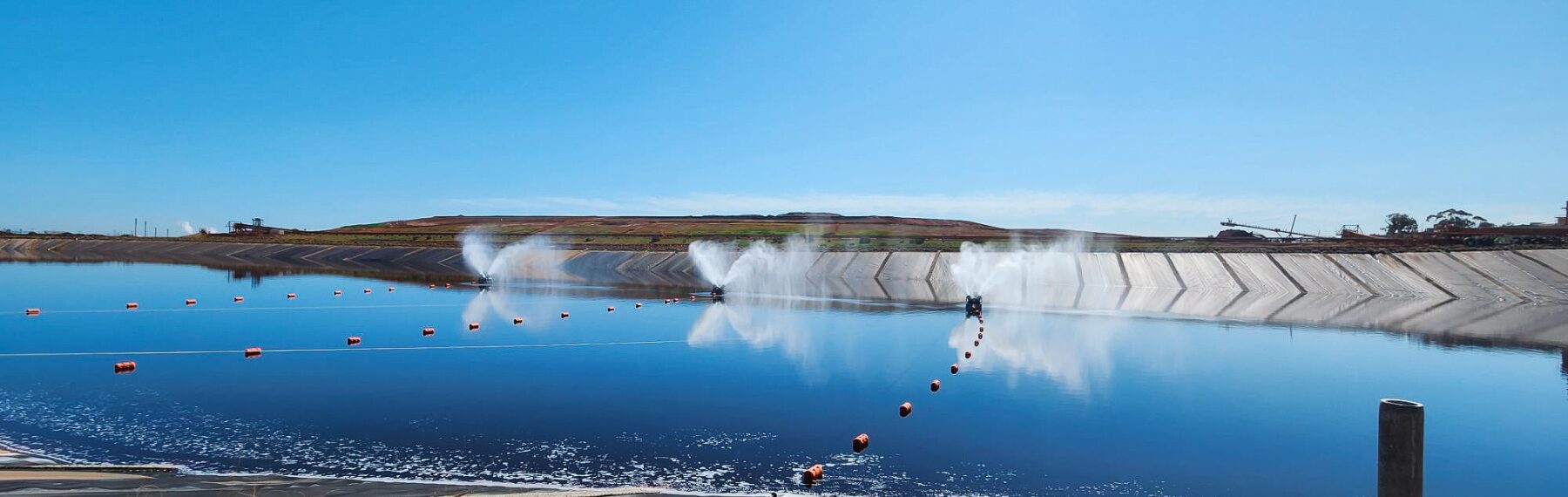
Minetek
Minetek is headquartered in Australia, with a North American office in Ohio and projects delivered worldwide. It supplies mechanical evaporation systems for high-volume, high-contaminant water, and represents the volume-reduction route to zero discharge. Its patented water-fracturing nozzle atomises wastewater into fine droplets and injects them into a high-velocity air stream, accelerating evaporation and reducing large water volumes directly on site. The process runs without chemicals or complex pre-treatment, and low-fouling nozzles handle acidic, caustic, and high-TDS or high-TSS water across the pH range. Floating and land-based units suit pits, tailings dams, and evaporation ponds, and an environmental management system adjusts operation to wind, humidity, and temperature.
Best fit: mining, oil and gas, and industrial sites that need rapid, lower-cost volume reduction to approach zero discharge rather than a full recovery plant. Common applications include pit dewatering, tailings management, and mine closure.
Aquatech International
Aquatech (United States) designs and supplies complete ZLD plants and is one of the most established names in the category, with more than 160 ZLD installations across six continents and a record as a pioneer of hybrid membrane-and-thermal ZLD. Its systems combine high-efficiency reverse osmosis, brine concentrators, falling-film evaporators, and crystallisers to recover 90 to 99 per cent of wastewater as reuse-grade water.
Best fit: large, complex plants in power, oil and gas, chemical processing, and critical-minerals recovery that need high water recovery and have the capital for a full train.
Saltworks Technologies
Saltworks (Canada, founded 2008) builds modular membrane and thermal systems for brine concentration, minimal liquid discharge, and full ZLD. Its line includes BrineRefine chemical softening, XtremeRO and FusionRO high-pressure reverse osmosis that concentrate brine to around 130,000 mg/L TDS, and the SaltMaker mechanical vapour recompression evaporator-crystalliser that produces solids. The same equipment is applied to lithium refining and materials recovery.
Best fit: tough, high-salinity brines and projects that want to minimise brine volume or recover valuable materials, with modular plants and mobile pilots for staged delivery.

Veolia
Veolia (France) is one of the largest global water-technology providers and delivers ZLD on a lump-sum, turnkey basis with a single point of responsibility, including long-term operation and maintenance. Its portfolio spans membrane pre-treatment, EVALED evaporators, brine concentrators, and crystallisers, and it builds wastewater reduction and ZLD systems of almost any size across most industries.
Best fit: large industrial projects that want one global supplier across the full water cycle rather than a single-stage specialist.
SUEZ
SUEZ (France) has more than 35 years in the design, delivery, commissioning, and service of ZLD systems. Its technology set covers brine concentrators, evaporators, and crystallisers, often combined with ultrafiltration, reverse osmosis, electrodeionisation, and ion exchange to suit the wastewater. SUEZ reports that its ZLD systems can cut a plant’s water consumption by up to 90 per cent while recovering high-purity water for reuse.
Best fit: industrial plants that want a complete, serviced ZLD system from an established global provider, with the option to recover saleable by-products.
Praj Industries
Praj Industries (India) offers end-to-end industrial wastewater treatment and ZLD on a one-stop basis, built on a reduce, recycle, and reuse approach. Its systems combine recycling and reuse with evaporation and crystallisation, including multi-effect evaporators and agitated thin-film dryers, and deliver more than 98 per cent water and resource recovery across steel, power, chemicals, fertilisers, food and beverage, textiles, and pharmaceuticals.
Best fit: industrial effluent ZLD where a single supplier handles the full treatment train, with strong coverage across India and Asia.

VA Tech Wabag
VA Tech Wabag (India) is a pure-play water company that designs, builds, and operates ZLD plants on an engineering, procurement, and construction basis, with a century-long legacy and projects across four continents. Its plants integrate membrane and thermal stages and have delivered more than 90 per cent recovery on high-salinity industrial effluents, with recent ZLD work for oil and gas, petrochemical, metals, and chemical clients.
Best fit: large industrial sites that want a single contractor to design, build, and run the ZLD plant over the long term.
| Supplier | Route | Core technology | Best fit | HQ |
|---|---|---|---|---|
| Minetek | Volume reduction | Water-fracturing atomising nozzles, floating and land-based units | Rapid, lower-cost volume reduction for high-volume mine and industrial water | Australia (HQ), USA, global delivery |
| Aquatech | Full recovery plant | High-efficiency RO, brine concentrators, evaporators, crystallisers | High water recovery at large, complex plants | Amerika Serikat |
| Saltworks | Full recovery plant, modular | XtremeRO/FusionRO, SaltMaker evaporator-crystalliser | High-salinity brine, volume minimisation, materials recovery | Kanada |
| Veolia | Full recovery plant, turnkey | Membrane pre-treatment, EVALED evaporators, crystallisers | Large projects wanting one global supplier | France |
| SUEZ | Full recovery plant, serviced | Brine concentrators, evaporators, crystallisers, plus UF/RO/EDI | Established global supplier with by-product recovery | France |
| Praj Industries | Full recovery plant, one-stop | RO recycling, multi-effect evaporators, ATFD | End-to-end industrial effluent ZLD, strong in Asia | India |
| VA Tech Wabag | Full recovery plant, EPC | Integrated membrane and thermal stages | Single contractor to build and operate the plant | India |
Choosing a ZLD supplier.
The choice comes down to two questions: what is in your water and how much of it you need to remove, and whether the goal is reuse-grade water recovery or fast volume reduction. A full recovery plant suits sites that need to reuse treated water in the process. For high-volume, high-contaminant water where cutting volume quickly matters more than recovery, mechanical evaporation is usually the lower-cost path to zero discharge, and that is where Minetek fits.
On a volume-reduction site, the case for Minetek’s mechanical evaporators rests on three points:
Lower cost.
Most of the spend in a ZLD plant sits in the thermal stage, with its membranes, brine concentrators, and crystallisers, and in alternatives such as new dam construction, water haulage, and conventional treatment. Removing water on site without chemicals or complex pre-treatment keeps both capital and operating cost down.
Fast deployment.
The units are modular and can be installed on an existing pit, tailings dam, or evaporation pond rather than requiring a new plant, so volume reduction can be running quickly.
Mobile and relocatable.
Both land-based and floating evaporators can be moved between sites or duties. Floating units mount on pontoons where a land-based setup is not practical, and that mobility suits short-term and emergency work as well as long-term site water management.
Frequently Asked Questions (FAQs)
Established ZLD suppliers for industrial plants include Minetek, Aquatech International, Saltworks Technologies, Veolia, SUEZ, Praj Industries, and VA Tech Wabag. Most build complete recovery plants that treat wastewater to reusable water and solids, while Minetek supplies the mechanical evaporation route that reduces wastewater volume on site to approach zero discharge.
For many high-volume, high-contaminant streams, yes. Mechanical evaporation removes water directly on site and reduces the waste volume until little or no liquid remains, without a membrane train or chemical pre-treatment. This route suits sites where cutting large volumes quickly and at lower cost matters more than recovering reuse-grade water. Plants that need to reuse treated water in the process usually add membrane recovery as well.
Zero liquid discharge removes effectively all liquid from a waste stream, leaving only solids and recovered water. Minimal liquid discharge stops short of that, concentrating the waste to a small residual brine that still needs disposal. Minimal liquid discharge usually costs less because it avoids the most energy-intensive final evaporation and crystallisation steps.
The thermal stage drives most of the cost. In a conventional ZLD plant, evaporation and crystallisation account for a large share of both capital and operating spend, which is why membrane pre-concentration and, on suitable sites, standalone mechanical evaporation are used to reduce the volume that reaches the thermal stage.
Mining, power generation, oil and gas, chemical and pharmaceutical processing, metals, and textiles all use ZLD. These sectors manage high-contaminant water and face strict discharge limits, which makes efficient volume reduction and on-site control important.