 Spanish
  English (United States)
  English
  Portuguese
  French
  Indonesian
  Italian
 What is water evaporation? Water evaporation is the process of converting water from a liquid into a vapour. Only the water molecules leave, so dissolved solids, salts and metals stay behind in a concentrated residue. That is also why evaporated water is clean: the contaminants cannot travel with the vapour.
For mining and industrial sites, mechanical evaporation puts that process to work, reducing the volume of water held in tailings dams and storage facilities without chemical treatment, without a new treatment plant, and often without raising or building a dam. This article compares water evaporation with water treatment across cost, compliance and operating requirements, and explains where each approach fits. Minetek’s mechanically enhanced evaporation processes water that conventional treatment struggles with, including high total dissolved solids, high total suspended solids, and a pH range from 1.8 to 14.
Key takeaways: Water evaporation vs water treatment
A quick summary for site operators weighing volume reduction against water treatment.
- What water evaporation is: a phase change that turns liquid water into vapour and leaves contaminants behind in a concentrated residue.
- Why evaporated water is clean: only water molecules vaporise, so dissolved solids, salts and metals stay in the residue.
- Operating cost: around US$0.20 per m³ evaporated, compared with roughly US$2 per m³ for water treatment.
- Water quality handled: high TDS and TSS, and a pH range from 1.8 to 14, without chemical pre-treatment.
- Capacity: systems operate in excess of 135 m³ per hour, configured to site requirements and scaled by adding units.
- Operation: 24/7 automated, low-maintenance operation with a fully integrated Environmental Management System that responds to conditions in real time.
- Best fit: reducing stored water volume, deferring or avoiding dam lifts, and supporting zero-discharge goals. Treatment remains the route where water must meet a discharge or reuse quality standard.
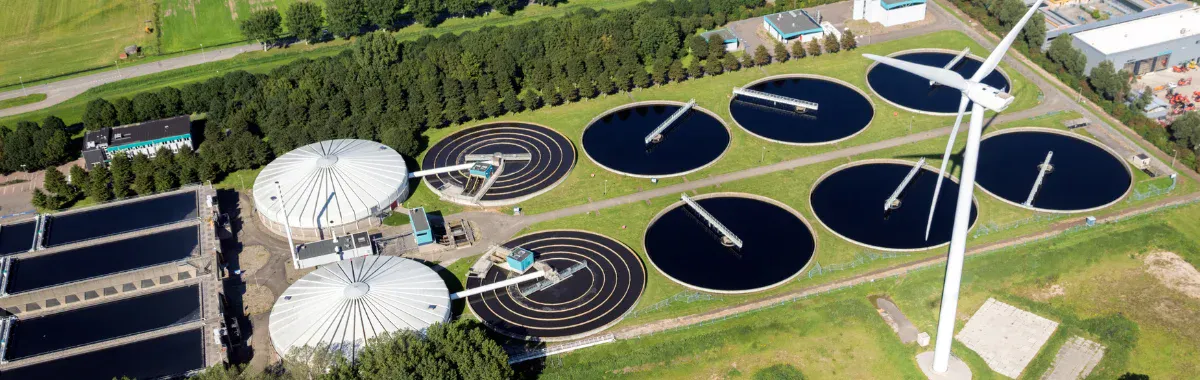
Water evaporation explained.
Water evaporation is the process of converting water from a liquid to a vapour. It happens naturally when sun and wind draw moisture from a surface, and it can be driven mechanically to remove water from dams, tailings storage facilities and process ponds far faster than nature alone.
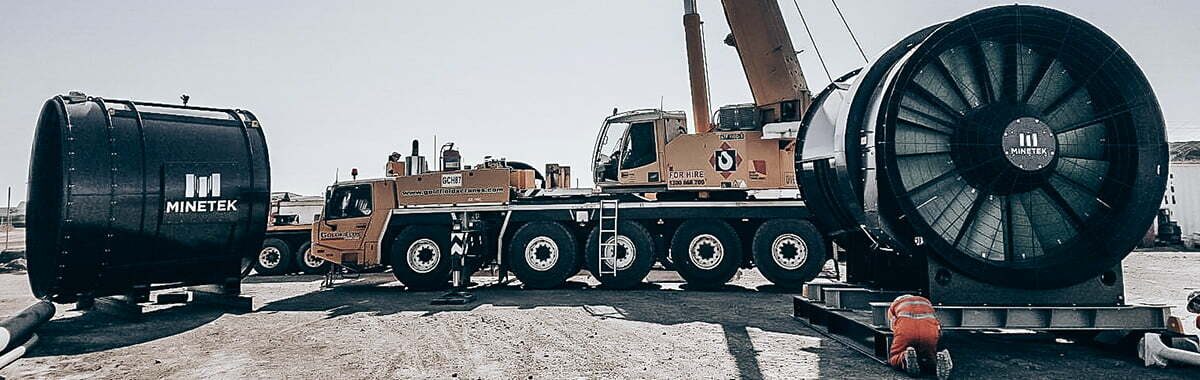
Minetek evaporators use a process called Mechanically Enhanced Evaporation (MEE). Feed water is delivered at high pressure to a series of patented fracturing nozzles, producing millions of droplets per second and a large increase in exposed surface area, well beyond what an evaporation pond can reach. A high-performance fan then lifts air speed past 150 km per hour, pushing the evaporation rate above the ambient pan evaporation rate that limits open ponds. In practical terms, this takes a natural process and accelerates it with engineering.
Because evaporation is a physical process rather than a chemical one, it does not need chemical pre-treatment, it produces no waste stream, and it is not thrown off by changes in feed water quality.
Evaporated water leaves contaminants behind.
When water evaporates, only the water molecules gain enough energy to leave as vapour. Dissolved solids, salts, heavy metals and suspended material do not vaporise, so they stay in the remaining liquid and concentrate over time. This is the reason evaporated water is clean: there is no mechanism for the contaminants to travel with the vapour.
For a mine or industrial site, that has a practical benefit. Evaporation removes water volume from a storage facility without adding chemicals and without generating a separate stream that then needs its own disposal. The contaminants remain contained on site in a smaller volume, and the water leaves as clean vapour.
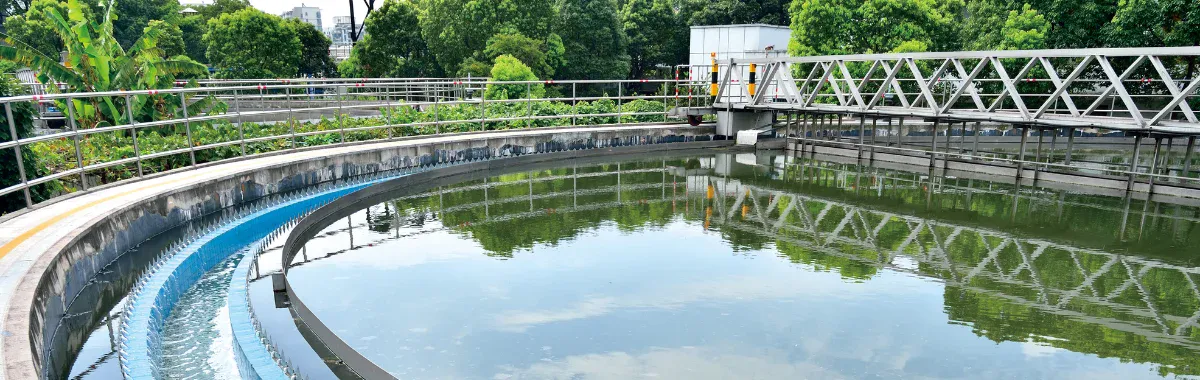
Water treatment methods: filtration, reverse osmosis, UV and distillation.
Water treatment makes water suitable for a defined use, whether that is safe discharge to the environment or reuse in an operation. It covers several methods, each targeting different contaminants:
- Filtration passes water through a physical medium such as activated carbon, cartridge or sand filters to remove particles.
- Reverse osmosis forces water through a semipermeable membrane to remove dissolved substances.
- Ultraviolet purification uses UV light to kill bacteria and other microorganisms.
- Distillation removes dissolved substances by evaporating water and condensing the vapour.
Treatment is effective and well understood. It removes at least 98% of organic contaminants and produces water that can be released or reused. Its trade-offs are cost and complexity: it uses significant electrical energy, needs chemicals such as chlorine, produces residuals to manage, requires ongoing maintenance and parts, and typically carries a lead time of three to four months to implement. It also has to be configured to target the specific contaminants present, so it is less forgiving when input water quality shifts.
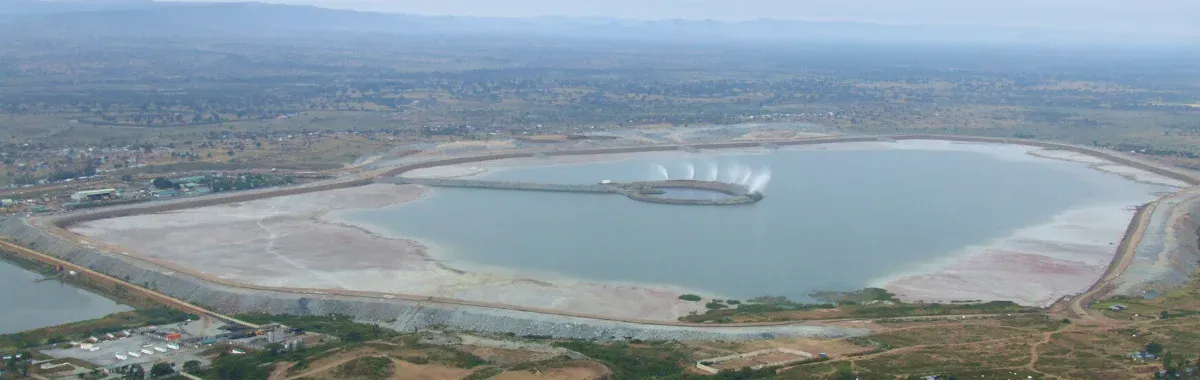
Water evaporation vs water treatment compared
The two approaches solve different problems. Evaporation reduces the volume of water a site is storing. Treatment produces water of a defined quality. The table below sets out the practical differences.
| Factor | Mechanical water evaporation | Water treatment |
| Primary purpose | Reduce stored water volume | Produce water to a discharge or reuse standard |
| Chemicals | None required | Chemicals required, including chlorine |
| Operating cost | Around US$0.20 per m³ evaporated | Around US$
Evaporation for high-TDS, high-TSS and extreme-pH waterSearches for an “evaporation water filter” often come from operators looking for a way to separate clean water from heavily contaminated water. Mechanical evaporation is not a filter in the membrane sense, and that is an advantage: there is no membrane to foul and no medium to replace. The separation happens through the phase change, so the process is not limited by how dirty or how chemically aggressive the water is. Minetek evaporation systems are built for that duty:
Illinois coal mine: reducing stored water toward zero dischargeA coal mine in the Illinois Coal Basin, at Williamsville, needed to dewater a 270-acre storage facility as part of long-term closure and reclamation. Around 140 million gallons of water had to be removed before reclamation could begin, and the site’s goal was to become a zero-discharge facility for environmental compliance. The challenge. The stored water sat well outside discharge limits:
Treating water of that quality by reverse osmosis was expensive, so the mine chose evaporation as a long-term route. The solution. Minetek supplied two land-based evaporators and a high-volume head pump, configured to process 400 GPM at 145 PSI. The results. Over a four-month period, the system:
2 per m³ treated |
| Waste stream | Sin flujo de residuos | Residuals such as sludge or spent carbon to manage |
| Feed water quality | Not affected by changes; handles high TDS, high TSS, pH 1.8 to 14 | Must target specific contaminants; removes at least 98% of organics |
| Labour | No necesita operario | Constant maintenance and cleaning |
| Despliegue | Quick to deploy | Lead time around three to four months |
| Speed on large volumes | Slower; a long-term solution | Faster processing |
Neither approach is universally better. A site that needs to draw down a tailings dam and defer a lift will get more value from evaporation. A site that must return water to a river at a set quality needs treatment. Many operations use both.
Where the water goes when it evaporates.
When water evaporates from a storage facility, two things happen:
- The water leaves as vapour. It disperses into the atmosphere as part of the natural water cycle.
- The contaminants stay behind. Dissolved solids, salts and metals cannot vaporise, so they remain in the storage facility as a smaller, more concentrated volume of water.
For mechanical evaporation, this separation is the point. The system moves clean water off site as vapour while keeping contaminants contained, which is what lets a mine lower the water level in a dam without discharging anything to the environment.
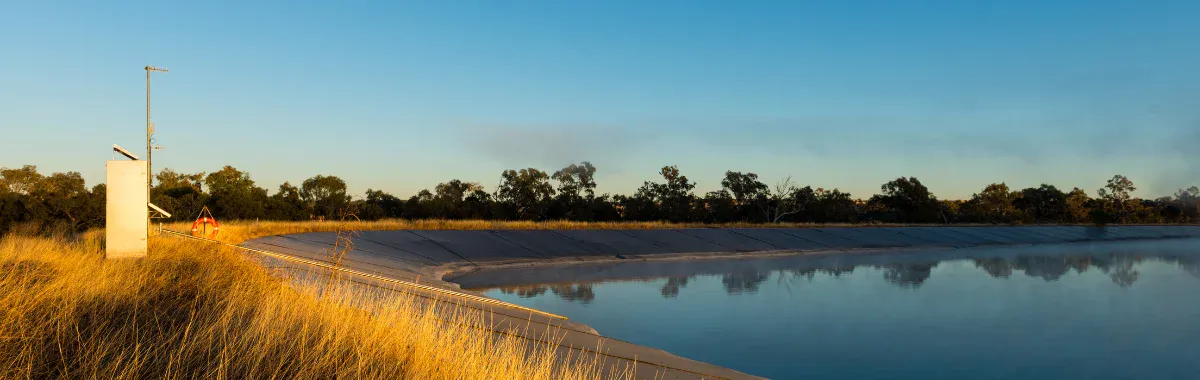
Evaporation for high-TDS, high-TSS and extreme-pH water.
Searches for an “evaporation water filter” often come from operators looking for a way to separate clean water from heavily contaminated water. Mechanical evaporation is not a filter in the membrane sense, and that is an advantage: there is no membrane to foul and no medium to replace. The separation happens through the phase change, so the process is not limited by how dirty or how chemically aggressive the water is.
Minetek evaporation systems are built for that duty:
- Capacity: systems operate in excess of 135 m³ per hour, configured to a site’s needs and scaled by adding units.
- Water quality: process high total dissolved solids and total suspended solids, and a pH range from 1.8 to 14, covering acidic and caustic streams that would foul or damage many treatment systems.
- Materials: low-fouling stainless steel nozzles and stainless steel filter systems handle aggressive water without the fouling that limits membrane-based methods.
- Positioning: unit angle adjusters let operators direct the spray to suit wind and site conditions.
- Footprint: mobile and modular systems deploy rapidly and need minimal footprint and power.
- Operation: 24/7 automated, low-maintenance running, with a fully integrated Sistema de Gestión Medioambiental (SGMA) that monitors conditions and responds to changes in real time.
- Track record: delivered and installed globally, with proven performance in all climates.
Illinois coal mine: reducing stored water toward zero discharge.
A coal mine in the Illinois Coal Basin, at Williamsville, needed to dewater a 270-acre storage facility as part of long-term closure and reclamation. Around 140 million gallons of water had to be removed before reclamation could begin, and the site’s goal was to become a zero-discharge facility for environmental compliance.
The challenge. The stored water sat well outside discharge limits:
- pH of 8.0 to 9.0
- Chlorides of 2,000 to 2,200 mg/l, against a permit limit of 500 mg/l
- Sulphates of 3,200 to 3,500 mg/l, against a limit of 2,000 mg/l
Treating water of that quality by reverse osmosis was expensive, so the mine chose evaporation as a long-term route.
The solution. Minetek supplied two land-based evaporators and a high-volume head pump, configured to process 400 GPM at 145 PSI.
The results. Over a four-month period, the system:
- Reached an evaporation rate above 30%
- Lowered the tailings storage facility by more than two feet
- Reduced total wastewater by around 38 million gallons, with 20 million gallons attributed to Minetek’s evaporators
Capital cost: water evaporation vs treatment and new dams.
The largest saving from mechanical evaporation is usually capital, not operating cost. Evaporation lets a site avoid or downsize a water treatment plant, and defer, reduce the size of, or avoid raising a tailings storage facility. Building a treatment plant, and raising or constructing a TSF, are among the most capital-intensive items on a mine’s water budget.
Against a treatment plant. For a site managing 15 ML per day, the capital difference is large:
- Water treatment CAPEX: US$40,000,000
- Minetek evaporation system CAPEX: US$4,030,856
- Approximate CAPEX saving: US$35,969,144
Against raising a dam. Raising or constructing a tailings dam is capital intensive, and evaporation can defer that spend by drawing the water level down. One gold mine client faced US$25 million per year to raise its TSF, and used a Minetek system to defer the lift for several years:
- Cost to raise the tailings dam: US$25 million per year
- Cost of the Minetek evaporation system: US$3.5 million
- Year one saving: US$21,509,048
- Year two saving: US$46,509,048
- Year three saving: US$71,509,048
Set against the cost of raising the dam wall, the capital saving is significant.
Talk to Minetek about reducing your stored water volume.
If your site is managing excess water in a tailings dam or storage facility, mechanical evaporation can reduce the volume without chemicals, without a new treatment plant, and without raising a dam. Minetek’s team scopes, designs and manufactures evaporation systems around a site’s water quality, climate and volume targets. Póngase en contacto con nosotros to discuss your water balance, or view the full range of land-based and floating evaporators.
Frequently Asked Questions (FAQs)
Water evaporation is the process of converting water from a liquid into a vapour. It happens naturally through sun and wind, and it can be driven mechanically to remove water from dams and tailings facilities. Mechanical evaporation reduces stored water volume without chemicals or a waste stream.
Evaporated water is clean because only water molecules vaporise. Dissolved solids, salts, heavy metals and suspended material cannot leave as vapour, so they stay behind in a concentrated residue. There is no mechanism for contaminants to travel with the water that evaporates.
The water leaves as vapour and disperses into the atmosphere as part of the water cycle. The contaminants it was carrying stay behind in the storage facility as a smaller, more concentrated volume, which is how evaporation reduces water levels without any discharge to the environment.
Mechanical evaporation separates clean water from contaminants through a phase change rather than a physical filter or membrane. There is no medium to foul or replace, and the process is not limited by how contaminated the water is. Minetek units handle high TDS, high TSS and a pH range from 1.8 to 14.
For reducing stored water volume, evaporation is usually the lower-cost route. Minetek evaporation runs at around US$0.20 per m³ evaporated, compared with roughly US$2 per m³ for water treatment, and it needs no chemicals, no operator and no separate waste stream. Treatment remains necessary where water must meet a discharge or reuse standard.
Yes. Mechanical evaporation is not affected by changes in feed water quality, so it handles high-salinity, high-TDS and high-TSS water and a pH range from 1.8 to 14, including acidic and caustic streams that would foul many treatment systems.